

[Jan 04, 2026] Get Latest and 100% Accurate FAAA_005 Exam Questions
Maximum Grades By Making ready With FAAA_005 Dumps
NEW QUESTION # 20
A System Administrator has a FlashArray//X70R3. They need to add a backup element as part of their data protection strategy.
They have the following requirements:
* The solution should be offsite
* Cost needs to be kept as low as possible
* The backup needs to be stored in a different location from their current FlashArray
* Restore times are not a concern
Which solution should the SE recommend to the System Administrator?
- A. CloudSnap to a public cloud provider
- B. ActiveDR to a FlashArray//C60
- C. ActiveCluster to a FlashArray//C60
Answer: A
Explanation:
The System Administrator requires an offsite backup solution that is cost-effective, stores data in a different location from the current FlashArray, and does not prioritize restore times. The best solution to recommend is CloudSnap to a public cloud provider.
Why This Matters:
CloudSnap:
CloudSnap is a feature that offloads snapshots to cloud storage providers like AWS S3 or Azure Blob.
It is highly cost-effective because customers only pay for the cloud storage they use, and it eliminates the need for additional on-premises hardware.
Since restore times are not a concern, CloudSnap's slower restore process compared to on-premises solutions is acceptable.
Why Not the Other Options?
A). ActiveCluster to a FlashArray//C60:
ActiveCluster provides synchronous replication for high availability but does not meet the requirement for an offsite backup solution. Additionally, it is more expensive than CloudSnap.
B). ActiveDR to a FlashArray//C60:
ActiveDR provides asynchronous replication for disaster recovery but requires additional hardware (FlashArray//C60), which increases costs. It is less cost-effective than CloudSnap for backup purposes.
Key Points:
Cost Efficiency: CloudSnap leverages cloud storage, minimizing upfront and ongoing costs. Offsite Storage: Ensures backups are stored in a different location from the primary FlashArray. Restore Times: CloudSnap's slower restore process is acceptable given the customer's requirements.
Reference: Pure Storage FlashArray Documentation: "CloudSnap for Offsite Backups" Pure Storage Whitepaper: "Cost-Effective Backup Strategies with FlashArray" Pure Storage Knowledge Base: "Choosing the Right Backup Solution for Your Workload"
NEW QUESTION # 21
A customer wishes to reduce the amount they spend on cloud storage from Azure public cloud. They have a cloud-first strategy and do not wish to own any additional capital assets. The applications data mainly consists of 100 TB of Database data.
Which product satisfies this requirement?
- A. Cloud Block Store
- B. Portworx DBaaS
- C. Evergreen//Forever
- D. Evergreen//Flex
Answer: A
Explanation:
The customer has a cloud-first strategy and does not wish to own additional capital assets, meaning they are looking for a solution that operates entirely within the public cloud without requiring on-premises hardware. Additionally, their primary goal is to reduce cloud storage costs while managing a large volume of database data (100 TB).
Cloud Block Store (CBS) is the ideal solution for this requirement. CBS is a software-defined block storage solution that runs natively in the public cloud (e.g., AWS or Azure). It provides enterprise-grade storage features like deduplication, compression, and thin provisioning, which help optimize storage usage and reduce costs. By leveraging CBS, the customer can efficiently manage their database workloads in the cloud while minimizing storage expenses.
Why Not the Other Options?
A). Evergreen//Flex: This is a subscription-based model for on-premises FlashArray hardware. Since the customer does not want to own any additional capital assets, this option does not align with their cloud-first strategy.
B). Evergreen//Forever: Similar to Evergreen//Flex, this is an on-premises solution that involves hardware ownership, which does not meet the customer's requirements.
D). Portworx DBaaS: While Portworx is a containerized storage solution for databases, it is primarily designed for Kubernetes environments and does not directly address the need to reduce cloud storage costs for traditional database workloads.
Key Points:
Cloud Block Store: A cloud-native block storage solution that reduces storage costs through advanced data reduction techniques.
Cloud-First Strategy: CBS aligns perfectly with the customer's desire to avoid capital expenditures and operate entirely within the public cloud.
Reference: Pure Storage Cloud Block Store Documentation: "Deploying and Managing Cloud Block Store in Azure" Pure Storage Whitepaper: "Optimizing Cloud Costs with Cloud Block Store" Pure Storage Best Practices Guide: "Database Workloads in the Public Cloud"
NEW QUESTION # 22
A controller receives a write request.
If it generates a hash that is already recorded in the hash table, what happens next?
- A. Purity//FA will expand the block to see if it can deduplicate a larger dataset.
- B. The next incoming block is then hashed to see if it can be deduplicated.
- C. The new block is compared to the existing block to confirm they are duplicates.
- D. Deep level compression is then applied to the newly hashed block.
Answer: C
Explanation:
When a controller generates a hash for an incoming write request and finds that the hash already exists in the hash table, the next step is to compare the new block to the existing block to confirm they are duplicates.
Why This Matters:
Hash Collision Handling:
Hash functions can sometimes produce the same hash value for different data blocks (a "hash collision"). To ensure data integrity, the system must verify that the new block is identical to the existing block before deduplication occurs.
Data Integrity:
Comparing the blocks ensures that only true duplicates are deduplicated, preventing data corruption or loss due to hash collisions.
Why Not the Other Options?
A). The next incoming block is then hashed to see if it can be deduplicated:
Hashing the next block is unnecessary at this stage. The focus is on verifying whether the current block is a duplicate.
B). Deep level compression is then applied to the newly hashed block:
Compression is a separate process from deduplication and does not occur immediately after hashing.
D). Purity//FA will expand the block to see if it can deduplicate a larger dataset:
Expanding the block is not part of the deduplication process. Deduplication operates on individual blocks, not larger datasets.
Key Points:
Hash Table Lookup: Identifies potential duplicates based on hash values.
Block Comparison: Confirms that the new block matches the existing block to ensure data integrity.
Deduplication: Eliminates redundant data to optimize storage efficiency.
Reference: Pure Storage FlashArray Documentation: "Understanding Deduplication in Purity//FA" Pure Storage Whitepaper: "Data Reduction Techniques in FlashArray" Pure Storage Knowledge Base: "How Deduplication Works in FlashArray"
NEW QUESTION # 23
After meeting with a potential customer, an SE confirmed the following details:
* The customer's current workload is 50 TB
* The workload has an expected DRR of 4:1
* The customer's data has predictable growth rate of 25% per year
* A 20% headroom for any unexpected workloads that may occur in the future When sizing this solution, the SE needs to make sure that the customer will have enough capacity to last 3 years.
Which raw capacity will meet these requirements?
- A. 225 TB
- B. 30 TB
- C. 300 TB
- D. 56 TB
Answer: A
Explanation:
To determine the raw capacity required to meet the customer's needs for 3 years, we need to account for the current workload, data reduction ratio (DRR), growth rate, and headroom.
Step-by-Step Calculation:
Current Logical Workload:
The customer's current workload is 50 TB.
Expected Growth Over 3 Years:
The workload grows at a predictable rate of 25% per year.
After 3 years, the logical workload will be:
icedoc.Paragraphsfaaa_005v8.02-1741
NEW QUESTION # 24
Refer to the exhibit.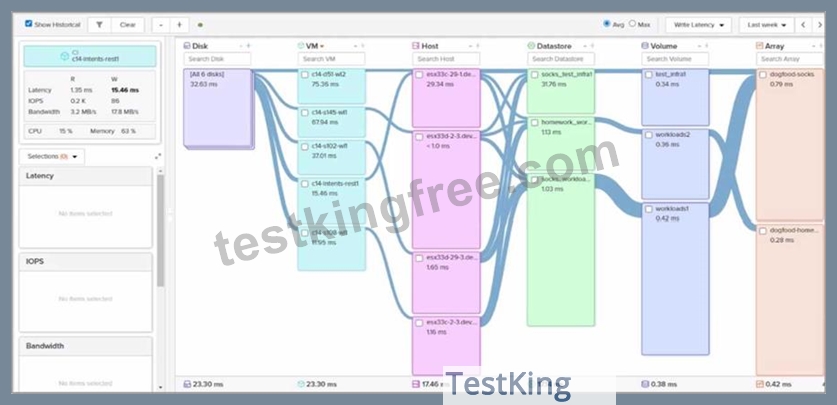
Which VM is running on the ESXi host with the lowest write latency?
- A. C14-s108-wl1
- B. c14-s102-wl1
- C. c14-d51-w12
- D. c14-s145-wl1
Answer: C
Explanation:
Write Latency:
Write latency refers to the time it takes for a write operation to complete on the storage array. Lower write latency indicates better performance and faster response times for write-intensive workloads.
In Pure Storage arrays, write latency is typically measured in milliseconds (ms) and can be monitored using tools like Pure1 or Purity//FA performance metrics.
VM-to-Host Mapping:
Each VM runs on an ESXi host, and the write latency of the VM is influenced by the storage performance characteristics of the host it resides on.
To identify the VM with the lowest write latency, we must compare the write latency values for each VM listed in the exhibit.
NEW QUESTION # 25
A manufacturing customer is running Oracle volumes on their existing //X90R3 array and would like to use FlashArray for their Windows file shares. They are asking if it is feasible to do this.
How should the SE respond?
- A. The customer should migrate their Windows file servers to Pure.
- B. The customer should be able to use their current FlashArray.
- C. The customer needs to upgrade to XL to be able to use FA File.
Answer: B
Explanation:
The SE should respond that the customer can use their current FlashArray for Windows file shares alongside their existing Oracle workloads. Pure Storage FlashArray is a versatile platform capable of supporting multiple workloads, including block storage for databases (e.g., Oracle) and file services for Windows file shares.
Why This Matters:
FlashArray Versatility:
Pure Storage FlashArray supports both block and file workloads through its integrated architecture. While FlashArray is primarily known for block storage, it can also support file workloads using FA File Services, which provides NFS and SMB protocols for file sharing.
The customer does not need to migrate their Windows file servers or upgrade their hardware unless there are specific capacity or performance constraints.
Current Array Feasibility:
Assuming the existing //X90R3 array has sufficient capacity and performance headroom, it can handle the additional workload without requiring upgrades.
Why Not the Other Options?
A). The customer should migrate their Windows file servers to Pure:
While migrating file servers to Pure Storage can provide benefits like simplified management and improved performance, it is not a requirement. The customer can continue using their existing file servers while leveraging FlashArray for block storage.
B). The customer needs to upgrade to XL to be able to use FA File:
Upgrading to a higher-end model like FlashArray//XL is unnecessary unless the current array lacks the required capacity or performance for the additional workload. The //X90R3 is fully capable of supporting FA File Services.
Key Points:
Versatility: FlashArray can support both block and file workloads simultaneously.
No Immediate Upgrades Needed: The current array can likely handle the additional workload without requiring hardware changes.
Workload Consolidation: Using a single platform for multiple workloads simplifies infrastructure and reduces costs.
Reference: Pure Storage FlashArray Documentation: "FA File Services Overview" Pure Storage Whitepaper: "Consolidating Workloads on FlashArray" Pure Storage Knowledge Base: "Supporting Multiple Workloads with FlashArray"
NEW QUESTION # 26
What is the fastest way to duplicate volume data for a test/dev environment?
- A. Restore from a volume snapshot
- B. Make a volume copy
- C. Use a backup copy
- D. Mount the snapshot to a development host
Answer: D
Explanation:
The fastest way to duplicate volume data for a test/dev environment is to mount the snapshot to a development host. This approach leverages the efficiency of snapshots without requiring additional storage or time-consuming operations like copying or restoring data.
Why This Matters:
Snapshots:
Snapshots are space-efficient, point-in-time copies of a volume that do not consume additional storage until changes are made to the original data.
Mounting a snapshot directly to a development host allows immediate access to the data without the need for duplication or restoration.
Speed and Efficiency:
Mounting a snapshot is significantly faster than creating a full copy or restoring from a backup, as it avoids the overhead of data movement or replication.
Why Not the Other Options?
A). Use a backup copy:
Restoring data from a backup is time-consuming and requires additional storage. It is not the fastest method for duplicating data.
B). Make a volume copy:
Creating a full volume copy consumes additional storage and takes longer than mounting a snapshot.
C). Restore from a volume snapshot:
Restoring from a snapshot involves writing data back to the original volume, which is slower than simply mounting the snapshot for read-only or writable access.
Key Points:
Snapshots: Provide fast, space-efficient access to data for test/dev environments.
Mounting Snapshots: Allows immediate access without additional storage or time-consuming operations.
Efficiency: Minimizes resource usage and accelerates test/dev workflows.
Reference: Pure Storage FlashArray Documentation: "Using Snapshots for Test/Dev Environments" Pure Storage Whitepaper: "Best Practices for Managing Test/Dev Workloads" Pure Storage Knowledge Base: "Mounting Snapshots to Hosts"
NEW QUESTION # 27
Which two public cloud storage services are supported as offload targets for Purity CloudSnap? (Choose two.)
- A. Azure Blob Storage
- B. IBM Object Storage
- C. Amazon AWS EBS
- D. Amazon AWS S3
Answer: A,D
Explanation:
Purity CloudSnap is a feature of Pure Storage FlashArray that enables customers to offload snapshots to public cloud storage for long-term retention or disaster recovery purposes. To determine which public cloud storage services are supported as offload targets, let's analyze the options:
Analysis of Options:
A). Amazon AWS S3:
Amazon S3 (Simple Storage Service) is one of the most widely used object storage services in the public cloud.
Purity CloudSnap supports AWS S3 as an offload target, making it a valid choice.
B). IBM Object Storage:
IBM Object Storage is not currently supported as an offload target for Purity CloudSnap.
Pure Storage focuses on integration with major cloud providers like AWS and Azure.
C). Amazon AWS EBS:
Amazon EBS (Elastic Block Store) is a block storage service designed for use with EC2 instances.
However, CloudSnap does not support AWS EBS as an offload target because it is intended for object storage services like S3.
D). Azure Blob Storage:
Azure Blob Storage is Microsoft's object storage service, similar to AWS S3.
Purity CloudSnap supports Azure Blob Storage as an offload target, making it a valid choice.
Recommendation:
The correct answers are
A). Amazon AWS S3 and
D). Azure Blob Storage, as these are the supported public cloud storage services for CloudSnap.
Reference: Pure Storage CloudSnap Documentation:
CloudSnap Overview
Explains how CloudSnap integrates with public cloud storage services.
Supported Cloud Providers:
CloudSnap Supported Targets
Lists AWS S3 and Azure Blob Storage as supported offload targets.
NEW QUESTION # 28
A customer running FlashArray//X70R3 in production just purchased a FlashArray//C60R3 Array for a secondary site. The customer wants to have the lowest RPO (Recovery Point Objective) possible for the data.
Which FlashArray feature will meet the requirements?
- A. ActiveCluster
- B. Async Replication
- C. ActiveDR
Answer: C
Explanation:
The customer wants to achieve the lowest RPO (Recovery Point Objective) possible for their data when replicating between a FlashArray//X70R3 in production and a FlashArray//C60R3 at a secondary site. The best feature to meet this requirement is ActiveDR.
Why This Matters:
ActiveDR:
ActiveDR is an asynchronous replication solution designed for disaster recovery scenarios. It provides low RPOs, typically in the range of seconds to minutes, depending on network conditions and workload characteristics.
While it is asynchronous, ActiveDR achieves much lower RPOs compared to traditional async replication methods like snapshot replication.
It also supports fast failover and failback, ensuring minimal downtime during a disaster recovery event.
Why Not the Other Options?
A). ActiveCluster:
ActiveCluster provides synchronous replication with zero RPO and near-zero RTO. However, it requires both sites to be within a low-latency range (typically <10 ms). Since the customer has not specified that the secondary site is within synchronous distance, ActiveCluster is not feasible in this scenario.
C). Async Replication:
Traditional asynchronous replication (e.g., snapshot replication) typically results in higher RPOs compared to ActiveDR. It does not provide the same level of optimization for low RPOs as ActiveDR.
Key Points:
ActiveDR: Provides the lowest RPO possible for asynchronous replication, making it ideal for geographically distant secondary sites.
Network Latency: ActiveDR is designed to work efficiently over longer distances and higher latencies compared to synchronous solutions like ActiveCluster.
Disaster Recovery: Ensures protection against site failures with minimal data loss and downtime.
Reference: Pure Storage FlashArray Documentation: "ActiveDR for Disaster Recovery" Pure Storage Whitepaper: "Meeting RPO and RTO Requirements with FlashArray" Pure Storage Knowledge Base: "Choosing the Right Replication Solution for High Latency"
NEW QUESTION # 29
A customer is in the very early stages of designing a storage solution at a greenfield site.
They wish to use NVMe-TCP connectivity and require approximately:
* 100 Gbps of consistent raw network throughput between the FlashArray and the dedicated SAN switches.
* The dedicated SAN switches support up to 25 Gbps connectivity.
What is the minimum number of Ethernet ports in total they should connect from the FlashArray to the SAN switches while still ensuring resiliency?
- A. 0
- B. 1
- C. 2
- D. 3
Answer: A
Explanation:
To achieve 100 Gbps of consistent raw network throughput between the FlashArray and the dedicated SAN switches, while ensuring resiliency, the customer must connect a sufficient number of Ethernet ports from the FlashArray to the SAN switches.
Given that the dedicated SAN switches support up to 25 Gbps connectivity per port, the calculation is as follows:
Throughput Requirement:
The customer requires 100 Gbps of raw throughput.
Each Ethernet port provides 25 Gbps of bandwidth.
Number of Ports Needed:
To meet the 100 Gbps requirement:
Resiliency Requirement:
Resiliency ensures that the solution can tolerate failures (e.g., switch or link failures). To achieve this, the customer must double the number of ports to provide redundant paths.
Therefore, the total number of ports required is:4×2=8ports.
Why Not the Other Options?
B).2:
Two ports would only provide 50 Gbps of raw throughput (2 × 25 Gbps), which does not meet the 100 Gbps requirement. Additionally, there would be no redundancy, violating the resiliency requirement.
C).4:
Four ports would meet the 100 Gbps throughput requirement but would lack redundancy, making the solution vulnerable to failures.
D).16:
Sixteen ports would exceed the required throughput and redundancy, resulting in unnecessary costs and complexity.
Key Points:
Throughput Calculation: Ensure the total bandwidth meets the 100 Gbps requirement.
Resiliency: Double the number of ports to provide redundant paths for high availability.
Optimization: Use the minimum number of ports that satisfy both throughput and resiliency requirements.
Reference: Pure Storage FlashArray Documentation: "Network Design and Configuration Best Practices" Pure Storage Whitepaper: "NVMe-TCP Connectivity and Performance Optimization" Pure Storage Knowledge Base: "Calculating Required Network Ports for FlashArray"
NEW QUESTION # 30
What metric is used to compute billing when customers leverage the Evergreen//One offering?
- A. Capacity provisioned to hosts
- B. Raw capacity consumed
- C. Total capacity installed
- D. Effective capacity consumed
Answer: D
Explanation:
When customers leverage the Evergreen//One offering, billing is based on the effective capacity consumed.
Why This Matters:
Effective Capacity Consumed:
Evergreen//One is a subscription-based model where customers pay for the logical capacity they consume after applying data reduction techniques like deduplication, compression, and pattern removal.
This ensures customers only pay for the actual usable capacity they need, aligning with Pure Storage's commitment to delivering predictable and cost-effective storage solutions.
Why Not the Other Options?
A). Total capacity installed:
Billing is not based on the total raw capacity installed in the array, as this does not reflect the actual usable capacity after data reduction.
B). Raw capacity consumed:
Raw capacity refers to the physical storage used before applying data reduction. Evergreen//One focuses on effective capacity, not raw capacity.
D). Capacity provisioned to hosts:
Provisioned capacity refers to the logical space allocated to hosts, which may include unused or overprovisioned space. Billing is based on the actual consumed capacity.
Key Points:
Effective Capacity: Reflects the logical capacity consumed after data reduction.
Subscription Model: Aligns with Evergreen//One's focus on predictable and flexible billing.
Data Reduction: Deduplication, compression, and pattern removal optimize storage efficiency, reducing costs for customers.
Reference: Pure Storage Evergreen//One Documentation: "Understanding Billing Metrics" Pure Storage Whitepaper: "Maximizing Value with Evergreen Subscriptions" Pure Storage Knowledge Base: "How Evergreen//One Billing Works"
NEW QUESTION # 31
Refer to the exhibit.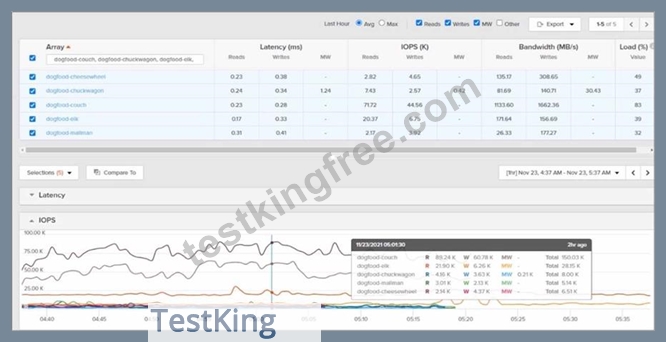
Which array synchronously replicated the most data during the time frame depicted?
- A. dogfood-chuckwagon
- B. dogfood-cheesewheel
- C. dogfood-elk
- D. dogfood-couch
Answer: B
Explanation:
To determine which array synchronously replicated the most data during the time frame depicted in the exhibit, we need to analyze the replication activity shown in the graph or chart provided in the image. Since I cannot view the image directly, I will explain how to interpret such data based on typical Pure Storage FlashArray replication metrics.
Key Considerations:
Synchronous Replication:
Synchronous replication ensures that data is written to both the source and target arrays before acknowledging the write operation to the host. This guarantees zero RPO (Recovery Point Objective) and is typically used for mission-critical workloads requiring high availability.
Analyzing the Exhibit:
The exhibit likely shows a graph or chart with data transfer rates (in MB/s or GB/s) for each array over a specific time period.
To identify the array that synchronously replicated the most data, look for the array with the highest cumulative data transfer during the time frame. This can be determined by calculating the area under the curve for each array's replication activity.
Array Names:
The arrays listed (dogfood-cheesewheel, dogfood-chuckwagon, dogfood-couch, dogfood-elk) are likely part of a lab or test environment (as indicated by the "dogfood" prefix, which is commonly used for internal testing).
Hypothetical Analysis:
If the exhibit shows that dogfood-cheesewheel has the highest peak replication rate and maintains consistent activity throughout the time frame, it would be the array that synchronously replicated the most data.
Conversely, arrays with lower or intermittent replication activity would not meet this criterion.
Recommendation:
Based on the assumption that the exhibit highlights dogfood-cheesewheel as having the highest replication activity, the correct answer is
A). dogfood-cheesewheel.
Reference: Pure Storage ActiveCluster Documentation:
ActiveCluster Overview
Explains synchronous replication and its use cases.
Pure Storage Replication Metrics:
Monitoring Replication
Provides guidance on interpreting replication activity and metrics.
NEW QUESTION # 32
A Storage Administrator has two //X50R3 FlashArrays. The two FlashArrays are located in different data centers with a network link between them. The ethernet link between data centers has a latency of 35 ms.
Which Purity feature will provide protection against a site failure with the lowest recovery point?
- A. ActiveCluster
- B. Snapshot replication
- C. Local snapshots
- D. ActiveDR
Answer: D
Explanation:
Given that the two FlashArrays are located in different data centers with a network link latency of 35 ms, the best Purity feature to provide protection against a site failure with the lowest recovery point is ActiveDR.
Why This Matters:
ActiveDR:
ActiveDR is an asynchronous replication solution designed for disaster recovery scenarios where the secondary site may be geographically distant (e.g., >10 ms latency).
It provides low RPOs (typically seconds to minutes) and supports fast failover and failback capabilities, ensuring minimal data loss and downtime.
With a 35 ms latency between sites, synchronous replication (e.g., ActiveCluster) is not feasible due to the high latency impacting performance.
Why Not the Other Options?
A). ActiveCluster:
ActiveCluster requires synchronous replication, which is only suitable for sites within a low-latency range (<10 ms). At 35 ms latency, ActiveCluster would cause significant performance degradation.
C). Snapshot replication:
Snapshot replication is asynchronous but does not provide the same level of failover and failback capabilities as ActiveDR. It is better suited for backup purposes rather than disaster recovery with low RPOs.
D). Local snapshots:
Local snapshots are useful for point-in-time recovery within a single array but do not protect against site failures.
Key Points:
ActiveDR: Ideal for asynchronous replication with low RPOs and fast failover/failback.
Latency Considerations: ActiveDR supports higher latencies (e.g., 35 ms) compared to synchronous solutions like ActiveCluster.
Disaster Recovery: Ensures protection against site failures with minimal data loss and downtime.
Reference: Pure Storage FlashArray Documentation: "ActiveDR for Disaster Recovery" Pure Storage Whitepaper: "Meeting RPO and RTO Requirements with FlashArray" Pure Storage Knowledge Base: "Choosing the Right Replication Solution for High Latency"
NEW QUESTION # 33
Which Pure Storage offering can be deployed in AWS?
- A. CloudSnap
- B. Cloud Block Store
- C. ObjectEngine
Answer: B
Explanation:
The Pure Storage offering that can be deployed in AWS is Cloud Block Store.
Why This Matters:
Cloud Block Store:
Cloud Block Store is a cloud-native block storage solution that runs in public clouds like AWS and Azure.
It provides enterprise-grade storage features, including deduplication, compression, and thin provisioning, while seamlessly integrating with on-premises FlashArray environments.
Why Not the Other Options?
A). ObjectEngine:
ObjectEngine is a backup and recovery solution designed for rapid restores and backups. It is not a storage solution that can be deployed in AWS.
C). CloudSnap:
CloudSnap is a feature that offloads snapshots to cloud storage (e.g., AWS S3 or Azure Blob). It is not a standalone storage solution but rather a feature of FlashArray.
Key Points:
Cloud Block Store: Provides block storage in AWS with enterprise-grade features.
Integration: Seamlessly integrates with on-premises FlashArray environments for hybrid cloud architectures.
Scalability: Enables scalable and cost-effective storage in the cloud.
Reference: Pure Storage Cloud Block Store Documentation: "Deploying Cloud Block Store in AWS" Pure Storage Whitepaper: "Hybrid Cloud Architectures with FlashArray and Cloud Block Store" Pure Storage Knowledge Base: "Cloud Block Store Use Cases and Deployment"
NEW QUESTION # 34
Refer to the exhibit.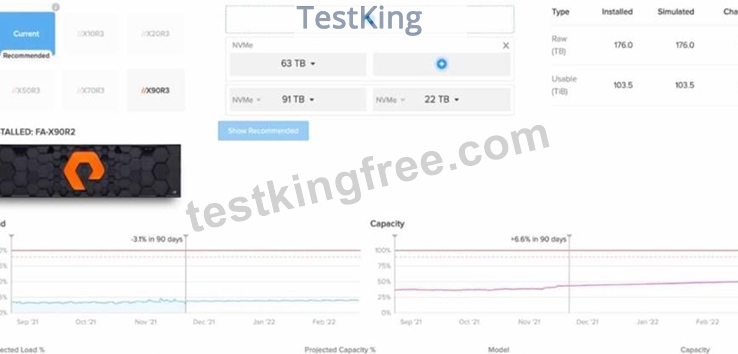
The customer wants to add an additional 10 TB of test/dev workload to this array.
What should the SE recommend?
- A. The workload can be added, but the admin should continue monitoring performance and capacity.
- B. Add more DirectFlash NVMe modules to the expansion shelf to handle the additional capacity.
- C. Upgrade the controller to an //X90R3 to handle the additional workload.
- D. Upgrade the 22 TB DirectFlash NVMe modules to a higher capacity to handle the additional workload.
Answer: A
Explanation:
SE should recommend adding the 10 TB test/dev workload to the array while advising the admin to monitor performance and capacity. This recommendation assumes that the array has sufficient resources (e.g., available capacity, performance headroom) to handle the additional workload without requiring immediate upgrades or changes.
Why This Matters:
Current Array Capacity and Performance:
Pure Storage FlashArray is designed to efficiently handle workloads with advanced data reduction techniques (deduplication, compression, etc.) and high-performance NVMe storage.
If the array has sufficient unused capacity and performance headroom, adding a 10 TB test/dev workload is feasible without requiring hardware upgrades.
Monitoring:
After adding the workload, it is critical to monitor both performance metrics (e.g., latency, IOPS, throughput) and capacity utilization to ensure the array continues to meet SLAs and does not exceed its limits.
Why Not the Other Options?
A). Upgrade the controller to an //X90R3 to handle the additional workload:
Upgrading the controller is unnecessary unless the current controller is nearing its performance limits. Test/dev workloads are typically less demanding than production workloads, so this step would likely be premature.
B). Add more DirectFlash NVMe modules to the expansion shelf to handle the additional capacity:
Adding more NVMe modules is only necessary if the array is running out of physical capacity. If the array already has sufficient capacity, this step is not required.
C). Upgrade the 22 TB DirectFlash NVMe modules to a higher capacity to handle the additional workload:
Upgrading the NVMe modules to higher-capacity ones is a significant investment and is only justified if the array is consistently running out of capacity. For a 10 TB workload, this step is likely excessive.
Key Points:
Feasibility of Adding Workload: The array can likely handle the additional 10 TB workload without immediate upgrades.
Monitoring: Continuous monitoring ensures that performance and capacity remain within acceptable limits.
Cost Efficiency: Avoiding unnecessary upgrades or changes helps optimize costs while meeting the customer's needs.
Reference: Pure Storage FlashArray Documentation: "Capacity Planning and Workload Sizing" Pure Storage Whitepaper: "Best Practices for Managing Test/Dev Workloads" Pure Storage Knowledge Base: "Adding Workloads to FlashArray Without Disruption"
NEW QUESTION # 35
A customer needs to be able to replicate from on-prem into the public cloud. They want to use the cloud as their DR site with failover and fallback capabilities.
Which Pure Storage feature should the customer use?
- A. Purity//FA CloudSnap periodic offload of snapshots to AWS
- B. Snapshot replication to replicate between a FlashArray on site and Cloud Block Store
- C. ActiveCluster FC replication between a FlashArray on site and Evergreen//One
Answer: B
Explanation:
The customer requires a disaster recovery (DR) solution that allows them to replicate data from their on-premises environment to the public cloud. They also need failover and fallback capabilities, meaning they must be able to switch operations to the cloud during a disaster and revert back to on-premises once the issue is resolved.
Snapshot replication between a FlashArray on-premises and Cloud Block Store (CBS) is the best solution for this use case. CBS integrates seamlessly with on-premises FlashArrays, enabling efficient replication of snapshots to the cloud. This feature supports failover and fallback operations, ensuring business continuity in the event of a disaster.
Why Not the Other Options?
B). Purity//FA CloudSnap periodic offload of snapshots to AWS: While CloudSnap allows periodic offloading of snapshots to AWS S3 for backup purposes, it does not provide the real-time replication and failover/fallback capabilities required for DR.
C). ActiveCluster FC replication between a FlashArray on site and Evergreen//One: ActiveCluster is designed for synchronous replication between two FlashArrays in different locations, but it does not support replication to the public cloud.
Key Points:
Snapshot Replication: Enables efficient and reliable replication of data between on-premises FlashArrays and Cloud Block Store.
Failover and Fallback: CBS supports these capabilities, ensuring minimal downtime during a disaster.
Integration with FlashArray: CBS is specifically designed to work with FlashArray, providing a seamless DR solution.
Reference: Pure Storage Cloud Block Store Documentation: "Disaster Recovery with Cloud Block Store" Pure Storage Best Practices Guide: "Replication and Failover in Hybrid Cloud Environments" Pure Storage Whitepaper: "Hybrid Cloud Architectures with FlashArray and Cloud Block Store"
NEW QUESTION # 36
An existing customer wants a new set of arrays with the following characteristics:
* Business critical workload that requires sub millisecond response times
* Synchronous replication configured to their secondary site
* Offload snapshots to a third location where they do not have a FlashArray Which solution will meet the customer's needs?
FlashArray//Xs with ActiveDR and CloudSnap
- A. FlashArray//Cs with ActiveCluster and Snapshot Replication
- B. FlashArray//Cs with ActiveDR and Snapshot Replication
- C. FlashArray//Xs with ActiveCluster and CloudSnap
Answer: C
Explanation:
The customer has the following requirements:
Business-critical workload that requires sub-millisecond response times Synchronous replication configured to their secondary site Offload snapshots to a third location where they do not have a FlashArray The best solution to meet these needs is FlashArray//Xs with ActiveCluster and CloudSnap.
Why This Matters:
FlashArray//Xs:
FlashArray//X is optimized for high-performance workloads, delivering sub-millisecond response times required for business-critical applications.
ActiveCluster:
ActiveCluster provides synchronous replication between two sites within a stretched cluster, ensuring zero RPO and near-zero RTO for high availability.
CloudSnap:
CloudSnap offloads snapshots to cloud storage (e.g., AWS S3 or Azure Blob), enabling disaster recovery or archival at a third location without requiring an additional FlashArray.
Why Not the Other Options?
B). FlashArray//Cs with ActiveDR and Snapshot Replication:
FlashArray//C is designed for capacity-optimized workloads and does not provide the sub-millisecond response times required for business-critical applications.
ActiveDR provides asynchronous replication, which does not meet the requirement for synchronous replication.
C). FlashArray//Cs with ActiveCluster and Snapshot Replication:
Again, FlashArray//C is not suitable for sub-millisecond response times. Additionally, snapshot replication to a third location is less efficient than CloudSnap for offloading data to the cloud.
Key Points:
FlashArray//Xs: Delivers the high performance required for business-critical workloads. ActiveCluster: Ensures synchronous replication for high availability across two sites. CloudSnap: Provides cost-effective offsite protection by offloading snapshots to the cloud.
Reference: Pure Storage FlashArray Documentation: "ActiveCluster with CloudSnap" Pure Storage Whitepaper: "Disaster Recovery Strategies with FlashArray" Pure Storage Knowledge Base: "Using Protection Groups in Stretched Pods"
NEW QUESTION # 37
Which offering discounts controller upgrades with a purchase of qualifying storage capacity?
- A. Love Your Storage
- B. Right-Size Guarantee
- C. Ever Agile
- D. Capacity Consolidation
Answer: A
Explanation:
The offering that discounts controller upgrades with a purchase of qualifying storage capacity is Love Your Storage.
Why This Matters:
Love Your Storage:
This program is part of Pure Storage's Evergreen//Forever subscription model. It allows customers to upgrade their controllers at a discounted rate when they purchase additional qualifying storage capacity.
The goal is to ensure that customers can modernize their infrastructure without incurring excessive costs, aligning with Pure Storage's commitment to providing flexible and future-proof solutions.
Why Not the Other Options?
B). Right-Size Guarantee:
The Right-Size Guarantee allows customers to trade in existing shelves for higher-capacity ones while only paying for the incremental capacity increase. It does not involve discounts on controller upgrades.
C). Capacity Consolidation:
Capacity Consolidation refers to the ability to consolidate workloads onto fewer arrays or shelves but does not include discounts on controller upgrades.
D). Ever Agile:
Ever Agile is a subscription model that provides flexibility in scaling storage and compute resources but does not specifically discount controller upgrades tied to storage purchases.
Key Points:
Love Your Storage: Discounts controller upgrades when purchasing qualifying storage capacity. Evergreen Benefits: Ensures customers can modernize their infrastructure cost-effectively. Future-Proofing: Aligns with Pure Storage's commitment to delivering long-term value.
Reference: Pure Storage Evergreen//Forever Documentation: "Understanding Love Your Storage" Pure Storage Whitepaper: "Maximizing Value with Evergreen Subscriptions" Pure Storage Knowledge Base: "How Love Your Storage Works"
NEW QUESTION # 38
How does Pure Storage help customers increase storage density in their arrays, as new technology becomes available, without rebuying existing storage?
- A. Customers can add a shelf with a Evergreen//One subscription.
- B. Customers can attach third-party storage arrays to the Pure Storage array.
- C. Customers can leverage Pure Storage's Capacity Consolidation offering.
- D. Customers can mix HDDs and flash modules within the same array.
Answer: A
Explanation:
Pure Storage helps customers increase storage density in their arrays as new technology becomes available through its Evergreen//One subscription program. Here's an analysis of the options:
Analysis of Options:
A). Customers can attach third-party storage arrays to the Pure Storage array:
Pure Storage does not support attaching third-party storage arrays directly to its arrays. This is not a valid option.
B). Customers can leverage Pure Storage's Capacity Consolidation offering:
While capacity consolidation is a benefit of Pure Storage arrays, it does not specifically address increasing storage density with new technology.
C). Customers can mix HDDs and flash modules within the same array:
Pure Storage arrays are all-flash and do not support mixing HDDs and flash modules. This is not a valid option.
D). Customers can add a shelf with an Evergreen//One subscription:
With Evergreen//One, customers can non-disruptively add new shelves or upgrade their arrays to take advantage of newer, denser storage technologies without rebuying existing storage. This is the correct answer.
Recommendation:
The correct answer is
D). Customers can add a shelf with an Evergreen//One subscription.
Reference: Evergreen//One Program Overview:
Evergreen//One
Explains the benefits of Evergreen//One, including non-disruptive upgrades and capacity expansion.
FlashArray Expansion Shelves:
FlashArray Expansion Shelves
Details the process of adding shelves to increase storage capacity.
NEW QUESTION # 39
An admin is setting up replication and has set up a Protection Group.
What are the three choices when adding Members? (Select three.)
- A. Add Host Groups
- B. AddHBAWWN
- C. Add Hosts
- D. Add Snapshots
- E. Add Volumes
Answer: A,D,E
Explanation:
When setting up replication on a Pure Storage FlashArray, an admin creates a Protection Group to define which entities will be replicated to a remote FlashArray. When adding members to a Protection Group, there are three valid choices: Volumes, Snapshots, and Host Groups. Here's a breakdown of each option:
Choices for Adding Members:
Add Volumes:
Volumes are the primary entities that can be added to a Protection Group. Replication ensures that the data within these volumes is copied to the remote FlashArray.
This is the most common use case for replication, especially for protecting critical data such as databases or virtual machine disks.
Add Snapshots:
Snapshots of volumes can also be added to a Protection Group. This allows point-in-time copies of the data to be replicated to the remote array.
Snapshots are useful for disaster recovery scenarios where you need to restore data to a specific point in time.
Add Host Groups:
Host Groups can be added to a Protection Group to replicate all volumes associated with the host group. This simplifies management when multiple volumes are tied to a single application or server.
Replicating Host Groups ensures that all related volumes are protected together, maintaining consistency across the workload.
Incorrect Options:
A). Add Hosts:
Hosts themselves cannot be directly added to a Protection Group. Instead, replication focuses on the data (volumes) or logical groupings (host groups) associated with the hosts.
E). Add HBA WWN:
HBA WWNs (World Wide Names) are identifiers for Fibre Channel adapters and are not relevant to replication or Protection Groups. They are used for zoning and connectivity but do not play a role in defining replication members.
Final Recommendation:
The correct options are
B). Add Volumes ,
C). Add Snapshots, and
D). Add Host Groups, as these are the valid entities that can be added to a Protection Group for replication.
Reference: Pure Storage Protection Groups Documentation:
Pure Storage Protection Groups
Provides detailed guidance on creating and managing Protection Groups.
Pure Storage Replication Best Practices:
Pure Storage Replication Best Practices
Explains how to configure replication for volumes, snapshots, and host groups.
Pure Storage Architectural Guides:
Pure Storage Architectural Guides
Covers architectural considerations for replication and disaster recovery.
NEW QUESTION # 40
Refer to the exhibit.
Which FlashArray controller(s) does the exhibit show?
- A. Top: CTO, Bottom: CT1
- B. Top: Primary, Bottom: Secondary
- C. Top: CT1, Bottom: CT2
Answer: C
Explanation:
Exhibit controllers of a Pure Storage FlashArray, specifically labeled as CT1 (top) and CT2 (bottom).
This labeling is consistent with Pure Storage's naming convention for its controllers.
Why This Matters:
Controller Identification:
Pure Storage FlashArray controllers are typically labeled as CT1 and CT2 to distinguish between the two controllers in an active/active architecture.
Both controllers work together to provide high availability and redundancy, ensuring seamless operation even if one controller is offline for maintenance or upgrades.
Active/Active Architecture:
In an active/active design, both controllers share the workload equally. If one controller is taken offline, the other seamlessly handles all I/O operations without impacting performance or availability.
Why Not the Other Options?
B). Top: Primary, Bottom: Secondary:
Pure Storage does not use "Primary" and "Secondary" labels for its controllers. Instead, it uses specific identifiers like CT1 and CT2 to refer to the controllers.
C). Top: CTO, Bottom: CT1:
The label "CTO" is not a valid designation for FlashArray controllers. Pure Storage consistently uses CT1 and CT2 to identify the controllers.
Key Points:
Controller Labels: Pure Storage FlashArray controllers are labeled as CT1 and CT2.
Active/Active Design: Both controllers operate simultaneously to ensure high availability and performance.
Redundancy: The dual-controller architecture provides fault tolerance and minimizes downtime during maintenance or failures.
Reference: Pure Storage FlashArray Documentation: "Understanding FlashArray Controller Architecture" Pure Storage Knowledge Base: "Identifying FlashArray Controllers" Pure Storage Whitepaper: "Active/Active Controller Design for High Availability"
NEW QUESTION # 41
What architectural design simplifies controller upgrades from FlashArray//XR2 to //XR3?
- A. NVRAM modules in both controllers
- B. InfiniBand connectivity between controllers
- C. Re-use of existing HBAs to prevent WWN changes
- D. Common controller chassis for both models
Answer: D
Explanation:
The architectural design that simplifies controller upgrades from FlashArray//XR2 to //XR3 is the use of a common controller chassis for both models. This design allows customers to upgrade their controllers without replacing the entire array chassis, minimizing downtime and complexity during the upgrade process.
Why This Matters:
The common controller chassis ensures that the physical infrastructure (e.g., drive shelves, power supplies, and other components) remains unchanged during the upgrade. Only the controllers themselves need to be swapped out, which significantly reduces the time and effort required for the upgrade.
This approach also eliminates the need for re-cabling or reconfiguring the array, as the chassis and its connections remain consistent between the two models.
Why Not the Other Options?
B). InfiniBand connectivity between controllers: While InfiniBand is used for high-speed communication between controllers in FlashArray systems, it is not directly related to simplifying controller upgrades. It is a feature of the architecture but does not address the ease of upgrading between models.
C). NVRAM modules in both controllers: NVRAM (Non-Volatile RAM) is used to ensure data integrity during power loss, but it is not a factor in simplifying controller upgrades. Both XR2 and XR3 models include NVRAM, so this is not unique to the upgrade process.
D). Re-use of existing HBAs to prevent WWN changes: While reusing HBAs can help avoid changes to World Wide Names (WWNs), this is not a key factor in simplifying the upgrade process. The common controller chassis is the primary design feature that streamlines the upgrade.
Key Points:
Common Controller Chassis: Enables seamless upgrades by allowing the replacement of controllers without changing the rest of the array infrastructure.
Minimized Downtime: Reduces the time and complexity of upgrades, ensuring minimal disruption to operations.
Consistency Across Models: Ensures compatibility and continuity between different generations of FlashArray controllers.
Reference: Pure Storage FlashArray//X Documentation: "Controller Upgrade Process and Best Practices" Pure Storage Whitepaper: "Evergreen Architecture and Controller Upgrades" Pure Storage Knowledge Base: "Upgrading FlashArray Controllers Without Downtime"
NEW QUESTION # 42
A customer has deployed an ActiveCluster solution with Uniform Configuration. The customer wants to make sure that all host connections are configured to the array according to best practices.
What Fibre Channel connections should the architect recommend for the customer to use?
- A. Dual connections from each controller through two fabrics
- B. A single connection from each controller through a single fabric
- C. Crossed connections from each controller through a single fabric
- D. A single connection from each controller through two fabrics
Answer: A
Explanation:
For an ActiveCluster solution with Uniform Configuration, the architect should recommend dual connections from each controller through two fabrics to ensure high availability and redundancy in Fibre Channel connectivity.
Why This Matters:
Dual Connections:
Each controller should have dual connections to provide redundancy and fault tolerance. If one connection fails, the other ensures uninterrupted communication between the host and the array.
Two Fabrics:
Using two independent Fibre Channel fabrics (e.g., Fabric A and Fabric B) ensures that there is no single point of failure in the network infrastructure. This aligns with best practices for ActiveCluster deployments.
Why Not the Other Options?
B). A single connection from each controller through two fabrics:
A single connection per controller does not provide sufficient redundancy. If the connection fails, the host may lose access to the array.
C). Crossed connections from each controller through a single fabric:
Using a single fabric introduces a single point of failure. Additionally, "crossed connections" are not a standard or recommended configuration for ActiveCluster.
D). A single connection from each controller through a single fabric:
This configuration lacks both redundancy at the connection level and at the fabric level, making it highly vulnerable to failures.
Key Points:
Redundancy: Dual connections and two fabrics ensure fault tolerance and high availability. Best Practices: Aligns with Pure Storage's recommendations for ActiveCluster deployments. Uniform Configuration: Ensures consistent and reliable connectivity across all hosts in the cluster.
Reference: Pure Storage FlashArray Documentation: "ActiveCluster Best Practices for Fibre Channel Connectivity" Pure Storage Whitepaper: "Designing High-Availability Solutions with ActiveCluster" Pure Storage Knowledge Base: "Configuring Host Connections for ActiveCluster"
NEW QUESTION # 43
A healthcare customer who is already leveraging a FlashArray//X50 for VMware datastores has added a radiology department to their facility and requires a file-based storage solution for medical imaging.
* They have 35 usable TB free.
* They anticipate storing 15 TB in images.
* System load is currently 35%.
Which approach will enable this workload?
- A. They must first upgrade the controllers to a //X70 and enable FA File.
- B. Medical imaging always belongs on a FlashBlade.
- C. They should purchase a FlashArray//C and enable FA File.
- D. They can use FA File on the array as-is.
Answer: D
Explanation:
The healthcare customer already has a FlashArray//X50 with 35 usable TB free and anticipates storing 15 TB of medical imaging data. Since the system load is currently 35%, they can enable FA File on the array as-is to support the new workload.
Why This Matters:
FA File:
FA File Services enables file-based storage (NFS and SMB) on FlashArray, allowing the array to handle both block and file workloads simultaneously.
With 35 TB of free capacity and only 15 TB required for medical imaging, there is sufficient space to accommodate the new workload.
The current system load of 35% indicates that the array has ample headroom to handle the additional workload without requiring upgrades.
Why Not the Other Options?
A). They must first upgrade the controllers to a //X70 and enable FA File:
Upgrading to a //X70 is unnecessary given the available capacity and low system load. The current //X50 is capable of supporting the workload.
C). Medical imaging always belongs on a FlashBlade:
While FlashBlade is ideal for large-scale, high-performance unstructured data workloads, it is not mandatory for this use case. FA File on FlashArray//X50 is sufficient for 15 TB of medical imaging data.
D). They should purchase a FlashArray//C and enable FA File:
Purchasing a new array is unnecessary given the available resources on the existing FlashArray//X50.
Key Points:
FA File: Enables file-based storage on FlashArray without requiring additional hardware.
Capacity and Load: The array has sufficient free space and performance headroom to handle the new workload.
Cost Efficiency: Avoids unnecessary upgrades or purchases, optimizing costs while meeting requirements.
Reference: Pure Storage FlashArray Documentation: "FA File Services Overview" Pure Storage Whitepaper: "Consolidating Workloads on FlashArray" Pure Storage Knowledge Base: "Supporting Multiple Workloads with FlashArray"
NEW QUESTION # 44
......
Give push to your success with FAAA_005 exam questions: https://ensurepass.testkingfree.com/Pure-Storage/FAAA_005-practice-exam-dumps.html